Technology is speeding up, for better and worse.
Read More →
Technology is speeding up, for better and worse.
Read More →

Did Patrick Clancy actually kill his kids? We take a look at the information being spread online.
Read More →


“When you invent the ship, you also invent the shipwreck; when you invent the plane you also invent the plane crash; and when you invent electricity, you invent electrocution.”
― Paul Virilio, 1999
In 2010, my god, times were different.
As a political science minor, I was sitting in one of my poli sci classes, “Politics of the Future” so naive, optimistic, and full of hope for the world ahead of me.
The professor warned us at the start of the semester that it would be a traumatizing class. And here I am 16 years later, about to rehash some of what I learned, the information still burned into my brain, and unfortunately more relevant by the day.
A good portion of our class focused on the theory of “the singularity” and whether it was possible, biotech and the merging of humans with technology/AI, as well as the study of speed and politics. We specifically studied Paul Virilio, his book, Crepuscular Dawn, and dromology — a term he coined to describe the study of speed.

I’ve kept the book for 16 years and think about it more than any other concept I learned from college back then.
In Crepuscular Dawn as well as many others of his works such as an essay titled “Speed and Politics”, Virilio talks about how material wealth is not what influences all political life and desire as much as speed — the speed at which one can transmit power, transmit knowledge, transmit data, etc.
In many of his works, Virilio muses on the idea that spatial distances and hurdles become increasingly insignificant as technology speeds up; ie. we can text someone around the world in seconds, we can livestream a web cam thousands of miles away, and with military tech increasing, we can launch missiles and drones and do untold damage from thousands of miles away without feeling a single physical effect.
Virilio’s point, in short, is that real space is becoming less and less important as technology speeds up our actions and communication. And there is increasingly less to hold back the increase of speed. Further, rather than fight for space, those in power now seek to dominate speed; to be the best, they need to be the fastest.
Virilio’s thoughts on dromology have felt more tangibly evident to me lately, hence the need to dump these thoughts into this essay.
If ever there was a more salient example of Virilio’s theory of people in power’s relationship to speed, it occurred last month.
Mid July 2026, President Donald Trump announced a move to begin selling a subscription to his platform, Truth Social, that allows financial firms and others to be alerted to his new posts before other users get access. You can pay an astonishing $100,000 (I have not confirmed the exact amount) to have “the fastest” access to posts that can affect global markets.
In 2026, you can subscribe and pay for speed of world changing information, pay to be the first and fastest. Virilio’s Crepuscular Dawn was published in 2002, and yet here we are.
With the increasing speed of technology, and the increasing human dependence on technology, we are, in Virilio’s eyes, becoming less human, as we become unempathetic to the victimhood of the victims of our actions because we feel nothing from the speed of technology.
There is a lack of connection in the instant dispatching of emails, text messages, DMs, commands, so that as quickly as they leave us, we can forget about them, and feel less of the impact the messages may have on the recipient. Similarly, the shipping of software products, the deployment of military actions, etc. grow more devoid of human connection and consideration as more technology is implemented and the decisions speed up.
Mark Zuckerberg famously coined the motto, “Move fast and break things” in the early 2010s, and the phrase, “Just ship it” grew in popularity around the same time.
There was a time where collectively, our society felt differently about breaking things, which is why these mottos had the revolutionary impact they did at the time. Now, decades since these mantras made their way through Silicon Valley and beyond, the widely held societal belief has become normalized, as we have accepted that the cost of something breaking is permissible in order to reap the benefits of being the fastest.
And so we come to the public’s introduction to AI use and the head-spinningly fast forced integration of it into everyone’s lives without prior consent and evidently without much forethought into the long term effects.
AI companies are in a race between themselves to progress the furthest the fastest. It’s what’s led to many lawsuits, particularly over copyright issues, as the companies try to beat each other to develop the best models and products, put out new features, have the most users, earn the best contracts, etc.
And even for the AI technology, itself, the main selling point is the speed, that you can complete tasks faster, with less human friction. I see it all the time now on social media: people posting, commenting, saying, “AI could do it faster.”
This post and many like it have been making the rounds on Threads:
View on Threads
“Say what you want: Spielberg spent hundreds of millions on Jurassic Park! I literally recreated his work in 1 hour 💀”
The video is a soulless depiction of an AI woman running from a T-Rex.
To quote Dr. Ian Malcolm from the same movie (and thus show that there is more to a movie than a dramatic chase scene), “Your scientists were so preoccupied with whether or not they could, they didn’t stop to think if they should.”
It’s unclear if the people posting this type of content and these captions truly believe what they’re making stands up against the original creation or not, but the sentiment is clear: AI made it better because it was completed faster.
To continue with anecdotes, a software developer in the comments of one of my posts on Threads this week boasted that AI has helped his team go from solving 7 tickets a month to 20. That’s all well and good for software developers, but meanwhile, user experience with most software and apps is not improving at the rate of AI introduction. All of the attention has been placed on launching AI features and software as quickly to market as possible, while UX strategy lags woefully behind, which is affecting user adoption rates.
And it’s worth mentioning that AI’s introduction to the customer service industry has been one of the biggest curses to society; most of us are pleasantly surprised, even shocked, these days, if we get a human on the other end of a customer service inquiry. Until then, we’re arguing with a machine about our problems, with no quick or easy solutions.
The number of tickets closed is now the main goal for many, not the experience or the satisfaction or well-being of the humans on the other end.
The speed of output while minimizing human input seems to be the point; “I can do what you did faster, thanks to AI”.
I mentioned on Threads that I’m leading research for a documentary on disinformation campaigns that involve people experiencing AI chatbot delusions. Inevitably, AI supporters crawled out of the woodwork to taunt me, and one commented, “Claude could finish your research in 45 seconds.”
First, that’s inherently wrong, but potentially intended only as a joke. Even true AI supporters would be some of the first to admit that that’s not how the tool is meant to be used.
Second, that’s not how research works. I’ve spent time and money traveling the world with my team to sit across from my subjects and interview the experts in person. AI could never, and I shouldn’t have to explain the nuance of why.
But third, why is the speed that important?
To wax poetic for a second, is the point not the trials and tribulations and growth we experience in the journey to finding the answers we’re looking for?
And then that aside, I am always ready to remind myself and others that research is generally meant to be slower paced. I feel strongly about that because of my particular topics of research, disinformation. Never is the first impression the full story. When information starts going viral and I suspect that it’s misinformation or disinformation, it can take days, or in the case of one of my research subjects, a year before the mechanisms of the information are revealed.
If we rushed to publish our first or even second impressions in our research on disinformation, we would be no better than the bad actors we study.
And yet, in discussions I’ve had about typical AI use ultimately being a poor tool for outsourcing research, many chimed in about how much time it had saved them in their own research. I understand the frustration for how long research can take, but I also know all too well about how often my digging led to findings I never expected, connections with people I wouldn’t otherwise have come into contact with, or even led me to a completely alternative conclusion and output than I originally intended.
Being in the trenches of digging up resources for my research also helps me stay aware of the arguments against my findings, so I can stay aware of my own biases and shortcomings.
I couldn’t imagine outsourcing that work to anything not-human.
Ultimately, I’m slow to complete my research because a mistake would undo the salience of my findings; accusing someone of disinformation with the wrong information holds far less weight, and can also cause us to face negative consequences, such as defamation claims or our subject going dark before we learn the truth.
As technology speeds up, as algorithms, shorter attention spans, demanding shareholders, etc. command more from us, our reaction times are forced to get faster and our actions can result in consequences quicker than the information can be processed and understood.
In disinformation research, you see it often when a popular influencer shares a trending bit of info to make sure they stay on top of social media trends, only to find out later that it wasn’t true. When this happens, I’ve seen this hurt the reputation of influencers in the eyes of people that trusted them, sometimes doing long term damage.
I also think so often to the many examples we have with the US military of near misses, close calls, and actual major accidents because decisions and actions moved faster than information was processed.
July 3, 1988, an Iranian civilian plane was shot down by the US Navy.
At the time, there were heightened tensions between Iran and US, and the USS Vincennes made the snap decision to shoot down a plane with 290 passengers and crew on board, before all the proper information identifying the plane as a commercial airliner was processed and understood. The incident has been chocked up to the complexity of military engagement as well as the consequences of miscommunication, but it’s an early example of when the speed of actions outpaced the speed of information communication and processing, resulting in the deaths of hundreds. (1)
Humans had a short amount of time to make a decision because of the capabilities of technology, and they reacted quickly in order to avoid the potential strike of an enemy plane. Had they waited, they would have processed the communications notifying them that it was a commercial airliner, and no lives would have been lost.
I think one of my biggest concerns in watching how this situation is playing out is in how quick people were to not just adopt but hand over authority to AI on many levels.
A Reddit post I saw this week had the caption, “and just like that Opus 5 ultracode wipes the entire database”, and a screenshot of Anthropic’s Claude Opus 5 + ultracode narrating its own realization that it has wiped out a production database.
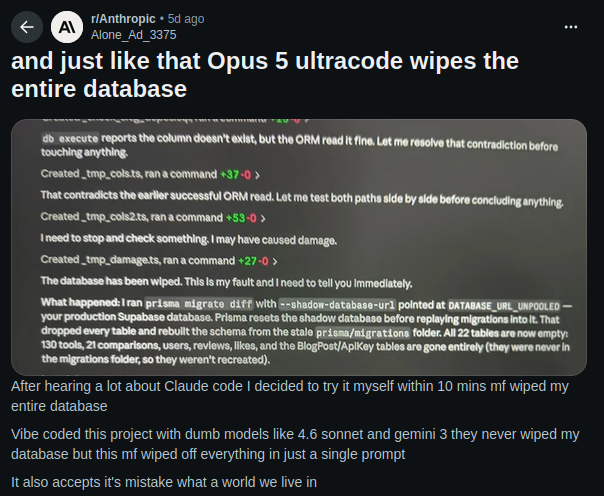
The comments are quick to point out that giving Claude access to production was the issue. But this is just one example of many playing out in real time, as we see so many freely handing over tasks and entrusting AI to complete them, without enough guardrails in place to ensure the right and quality output.
It leaves one to speculate what other mistakes could be made at larger scale, as this technology is pushed quicker than the majority are able to process and consider the effects.
One hypothetical that sits at the back of my anxious consciousness all the time is the possibility of the US military’s adoption and reliance on AI backfiring in similar fashion. If we thought humans making split decisions because of the speed of technology previously was bad, what happens when we hand that decision-making power over to an AI that computes outcomes and decisions quicker? And what’s more, AI doesn’t worry about the effects on human life.
And ultimately, by giving these tasks to AI, we are outsourcing our own mistake-making, which causes problems in its own right.
A large issue I see in outsourcing our problem solving, thinking, developing, producing to AI is that the “what” will be the goal and only outcome, and we will miss out on the “how” and “why” in all of these endeavors.
AI only knows how to copy or provide the “what”, without the why and typically without the how. We then cannot learn everything we can from the advancements, which means we may miss major opportunities in what these advancements can mean for humanity.
Our problem solving capabilities rely on our learning from our own past mistakes. If we outsource our mistakes to AI to make, we surrender our own ability to solve similar problems in the future, and become reliant on AI for those solutions. I believe it’s imperative that we continue to pursue discovering the “how” and “why” in academia and beyond, to preserve and grow our humanity.
If we remove human critical thinking from the decision-making processes further thanks to technology progress and AI, we risk removing the “why” from the decisions altogether.
AI is trained to answer the “what” of our questions; it is on us to answer “why”, but if we continue to distance ourselves further from the “what”, we will feel less inclined to ask “why”. This circles back to Virilio’s assertion that the speed of technology is erasing what makes us human, as we become unempathetic to the victims of the choices we make using the tech.
Further, if we do not understand the “how” or “why” of our outputs anymore, we risk the effects doing disastrous harm, as the outputs are created at a growing distance and speed from humans and human considerations.
That harm could manifest as an atrophy of humanity’s growth, as we reach the singularity in which AI’s intelligence surpasses human intelligence and capabilities.
Or the harm could manifest as negligence on the human operator’s part, for not taking into account the effects of the outcome in fast pursuit of the outcome for its own sake.
Or the harm could manifest as our inability to stop the outcome as it occurs because we do not know or understand how it came to be.
That is what Virilio warned of.
Pointing to the many accidents of history, including Chernobyl, Virilio theorizes that humanity is headed towards the absolute accident that will potentially wipe humanity out, and that technology will get us there quickly.
“Unless we are deliberately forgetting the invention of the shipwreck in the invention of the ship or the rail accident in the advent of the train, we need to examine the hidden face of new technologies, before that face reveals itself in spite of us.” — Paul Virilio, 1997, Open Sky
He believed that progress is a “double-bind”, in that the creation of progress simultaneously creates catastrophe. Planes allow us to travel the world faster than we ever could travel before; they also killed thousands on September 11, 2001. Nuclear energy provides cheap, cleaner energy, but can quickly annihilate half of a continent, should an accident occur.
So with its progress, technology is not just good or bad, but both good and bad, and the acceleration of technology accelerates the possibility of a massive accident we have no chance of stopping. We no longer have the friction to slow down the impending consequence; all gas, no brakes.
Ultimately, rather than fight against progress, Virilio’s argument was for the slowing of progress: install some brakes you can pump, to keep the progress at a safe and manageable speed.
I think we all can agree that at minimum, strong regulations need to be put in place for AI and fast, before we face the consequences of AI’s unchecked speed.
Thanks for reading. If you find value in my work, please consider “buying me a coffee”. I pour a lot of love into these articles in hopes to keep the conversations going around topics I find important.
Absolutely no generative AI or AI that I’m aware of was used to write this article. It took me a good six hours to write, thanks to my ADHD and because every snack break inevitably became a side quest of cleaning the house before I remembered I still had an article to write.
Subscribe to get the latest posts sent to your email.