Minnesota cyberattacks, Google Earth deepfakes, and Anthropic’s destroying books?
Read More →
Minnesota cyberattacks, Google Earth deepfakes, and Anthropic’s destroying books?
Read More →
Did Patrick Clancy actually kill his kids? We take a look at the information being spread online.
Read More →

Technology is speeding up, for better and worse.
Read More →


Capital punishment is the ultimate price to pay for the most heinous, depraved crimes. The death penalty has again infiltrated popular discourse thanks to recent events including Christa Pike’s botched execution, in which she is the first person in history to have survived two lethal injections, as well as California Governor Newsom sparing the lives of all 548 death row inmates by commuting their sentences.
The dialogue around both events has been nuanced, with no real consensus on whether the majority is for or against the death penalty. But the real issue is that there is a swirl of misinformation around the death penalty that regularly is repeated in public commentary on these events.
Some common misconceptions, corrected:
The death penalty has a long history with humankind, dating back as far as the Eighteenth Century BCE in the Code of King Hammaurabi of Babylon (History of the Death Penalty, n.d.). Some of the execution methods may be familiar, as crucifixion has been popularized in history thanks to Christianity.
Over the years, humanity has experimented with various execution methods, from hanging to firing squad to electric chair. The vast majority of the western world has abolished the death penalty, generally viewing it as barbaric.
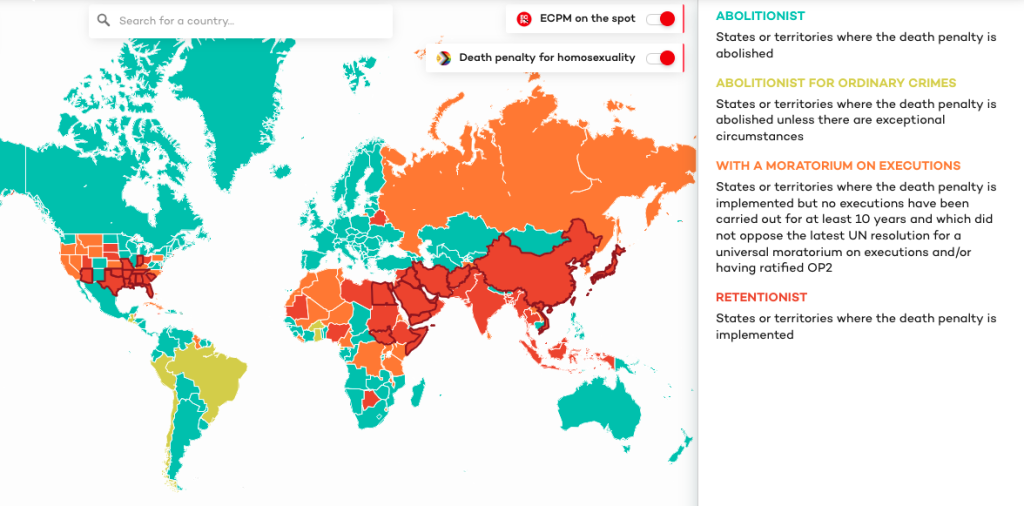
https://www.ecpm.org/en/worldmap/
The United States allows each state to decide its stance on the death penalty. As of 2025, 27 states have the death penalty. Of those states, California, Ohio, Oregon, and Pennsylvania have had the death penalty paused by executive action.
The general consensus amongst states with the death penalty is that lethal injection is the most humane. The issue is that in the past 120 years, 75 lethal injection executions have been botched.

Christa Pike.
On September 30, 2026, Christa Pike, a death row inmate in Tennessee, survived two lethal injections, the first ever in history (Wiley, 2026). The current theory is that the IV line for the injections was placed incorrectly in her arm, and the lethal pentobarbital was injected into her tissue rather than her veins.
This has left her in immense amounts of pain, and uncertain about what her now unexpected future holds.
This was the second botched execution in Tennessee this year, by the same doctor, Mark Fowler. The state of Tennessee has halted all executions for the remainder of 2026 to investigate.
Pike is currently requesting that the state of Tennessee end her isolation in the Nashville prison. The state is arguing against it, stating that her medical care requires her to be in isolation for at least the time being (Wright & Fisher, 2026).
A formal complaint has been filed about the executions in Tennessee under their 2025 Lethal Injection Protocol, and the complaint has been updated to include details from Christa Pike’s execution attempt. This is following Pike’s lawsuit filed in January 2026, prior to her execution, that stated, “Tennessee’s new lethal injection protocol, calling for single drug (pentobarbital), is plagued with the same issues that have marked botched executions for decades: secrecy, intentional omission, inattention to detail, and untrained and unlicensed prison personnel attempting to fill medical roles.”
There is currently no plan for her release. There has been some speculation online that she would ask for this, due to what she has gone through, alleging that this punishment was enough retribution and further punishment is violating her Eighth Amendment rights protecting her from cruel and unusual punishment. It is unlikely that Tennessee will grant her clemency.
In criminology, feminist pathway theorists and studies like Belknap and Holsinger (1998, p. 32) posit that the majority of women offenders were first victims, themselves, and that that victimization can continue even after they offend.
Pike is a prime example of this. She endured an enormous amount of trauma through her childhood, starting with her birth to an alcoholic mother. There is even some evidence that her mother was possibly suffering from postpartum depression after her birth, as one of the dockets from her court mentions that her mother attempted suicide shortly after Pike was born (Pike v. Tennessee, No. 26-5696, Appendix C, p. 4). This disorder continues to make the news thanks to cases like Andrea Yates, and more recently Lindsay Clancy.
Throughout Pike’s life, she experienced neglect from her abusive parents, saw violence regularly in her family, and was physically and sexually abused and raped by various men on numerous occasions, including multiple family members and her mother’s partners. No one in her life reportedly saw consequences for their actions against her, aside from one neighbor who had sexually assaulted her, and even then, he only served a short sentence.
The court experts in her case allege that she suffered from bipolar disorder and PTSD, and that these, combined with her past, led to her criminal behavior.
Pike is an example of how the system fails us. While many argue that her death would be justice for her victim, it is hard to demonstrate any real progress for the human race in the eye-for-an-eye mentality.
The real progress would have been found in using her life and crime as an opportunity to learn from society’s mistakes and improve our mental health care and protections for children. Pike suffered abuse after abuse, and saw little to no justice in the offenses against her, and yet she was sentenced to pay the ultimate price for her own, albeit, heinous crime.
It is hard to imagine what life would be like, to only know justice when it is leveled against you, but never in your favor when you needed it.
Without personally knowing Pike, I don’t have an opinion on if she deserves full clemency in light of the punishment she has endured. I do believe, at minimum, she deserves another chance at healing and rehabilitation. I hope that Tennessee will grant her that, at least
On November 5, 2026, Governor Newsom announced in a letter that he was commuting the sentences of every person on death row in California.
“I take this action because I firmly believe that state-sanctioned killing is incompatible with California’s values, undermines the foundations of our legal system, and diminishes each of us,” he wrote. “I know we cannot execute people in our imperfect legal system and remain true to our core values, first among them justice and human decency.” (Newsom, 2026)
This is not a novel move for Newsom.
In March, 2019, Governor Newsom announced:
“The intentional killing of another person is wrong and as Governor, I will not oversee the execution of any individual. Our death penalty system has been, by all measures, a failure. It has discriminated against defendants who are mentally ill, [B]lack and [B]rown, or can’t afford expensive legal representation. It has provided no public safety benefit or value as a deterrent. It has wasted billions of taxpayer dollars. Most of all, the death penalty is absolute. It’s irreversible and irreparable in the event of human error.” (Governor Gavin Newsom Orders a Halt, 2019)
His November 2026 announcement made sure to include an acknowledgment of the grief that the victims’ families and friends have already endured, and the pain that the announcement may bring in resurfacing their stories.
All of those on death row in California have had their sentences commuted, and will now be sentenced to life without parole in prisons across the state. This commutation is pending approval of California’s Supreme Court for those twice-convicted of a felony, according to California’s Constitution.
Many victims’ rights groups and organizations have stated that they will be legally challenging the commutation, saying that this goes against juries, trials, and due process that had already decided on these sentences (Faheid & Sayers, 2026).
This is not the end of the death penalty in California. The death penalty can only be abolished by means of voting by the people. A governor, however, holds the right to pause executions while they are in office.
To that end, Governor-Elect Xavier Becerra has stated that he plans to maintain the moratorium on executions.
Some on social media mistook this commutation to mean that the death row inmates would be released from prison, but that is far from the truth. All will likely die in prison, serving life without parole.
Many have opined that this move is strategic, as Newsom is vying for a potential run for President in 2028. That may be so, but this has been a stance that Newsom has held since he became governor in 2019. Even if this is a move for a presidential campaign, and my own opinion of that aside, consistency in a candidate is a valuable characteristic that is hard to come by these days.
Personally, I view this as a win for the justice system. Death Penalty Information Center estimates that 4% of executions have resulted in exonerations after death. California has had eight exonerations since 1973. That is eight too many.
A fundamental cornerstone of our justice system is that we would rather ten guilty men go free than see one innocent charged. Though we fail to uphold that virtue often, this move on Newsom’s part aligns with that value.
No guilty, in this instance, will go free, but it does give any innocent on death row a proper chance at due process and potential exoneration if they were to be found innocent on appeal.
Our justice system is flawed, heavily burdened with complex procedures, and further complicated by mercurial politics. Allowing the state to end someone’s life is a weighty amount of power that I do not think the government should be allowed.
The death penalty is a permanent solution to a nuanced problem, and I maintain that it should be abolished nationally. It is my hope that both of these events in the news can stir up these conversations so that progressive steps can be made for the betterment of our justice system and our country’s values.
Thanks for reading. I have a passion for researching criminal justice, justice reform, misinformation and disinformation, and correcting the misinfo I discover when I can. If that’s all something you’re into, please consider subscribing. If you find value in my work, please also consider buying me a coffee.
Sources
Subscribe to get the latest posts sent to your email.